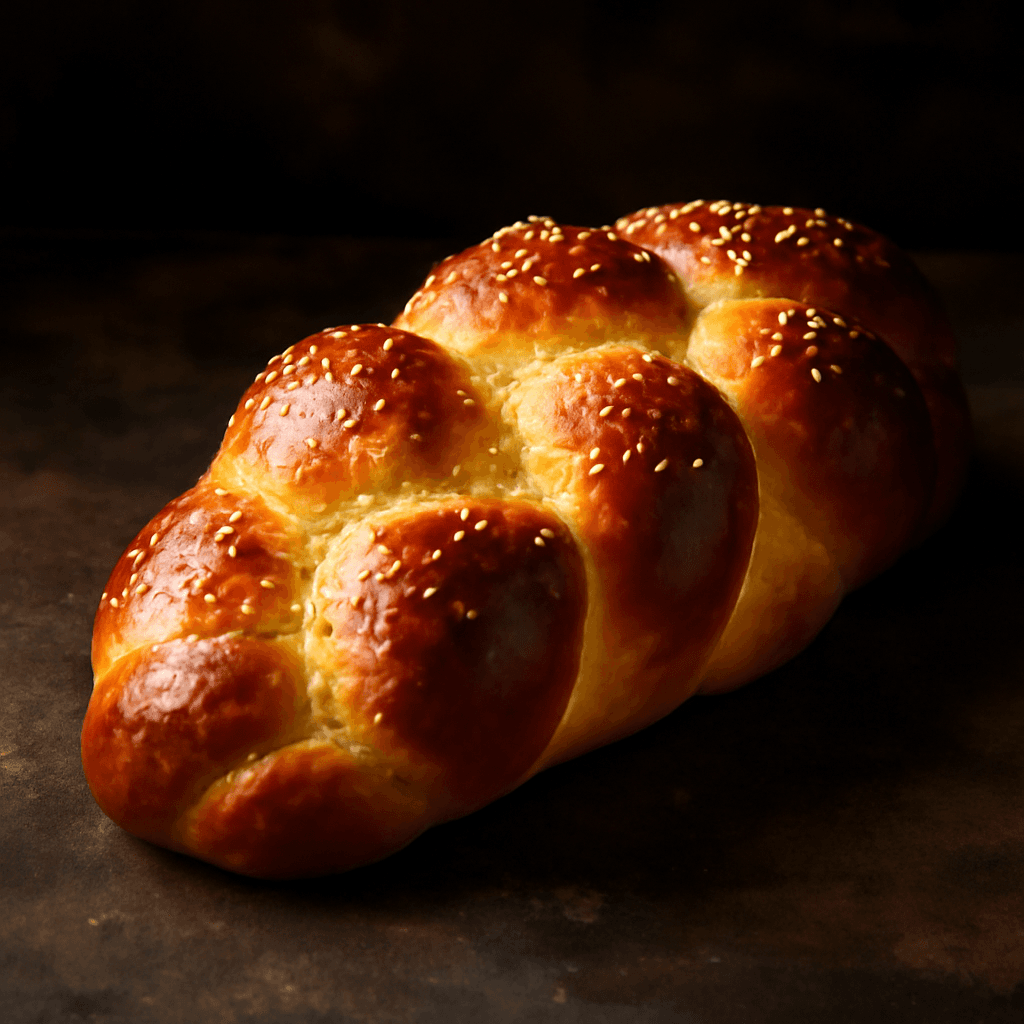
Challah - freshly baked bread

Challah

French & European-Style Bread

Beautiful braided egg bread with a golden, glossy crust and a soft, rich crumb. A celebration bread for special occasions.

Prep Time

25 min

Proof Time

1h 30m

Bake Time

30 min

Servings

10

Calories

230

Ingredients

  • 3 cups bread flour
  • 2¼ tsp active dry yeast
  • 1 cup warm water
  • 2 tbsp unsalted butter, softened
  • 2 tbsp sugar
  • 1½ tsp salt
  • 2 large eggs

Instructions

  1. 1

    Activate Yeast

    Dissolve sugar in warm water. Add yeast and wait 5 minutes.

  2. 2

    Mix Dough

    Add butter, eggs, salt, and flour. Knead 10 minutes until smooth.

  3. 3

    Rise

    Cover and rise 60–90 minutes until doubled.

  4. 4

    Shape

    Shape as directed — braid, round, or loaf.

  5. 5

    Second Rise

    Cover and rise 30 minutes.

  6. 6

    Bake

    Brush with egg wash. Bake at 375°F (190°C) for 25–30 minutes until golden.

Baker's Notes

European breads often benefit from a long, slow fermentation. Even an extra hour of rise time develops noticeably more flavour.

Baker Thomas Moreau

About This Recipe

Challah is one of those breads that transforms a simple kitchen into something celebratory. With its rich egg-enriched dough, glossy golden crust, and tender crumb, it carries warmth through every bite. There's something deeply satisfying about watching the strands come together during braiding—what feels like a puzzle quickly becomes muscle memory.

Canadian home cooks have embraced this European tradition for its versatility. It shines alongside Sunday brunch spreads, serves beautifully at holiday tables, and freezes remarkably well for weekday breakfasts. The kind of bread that makes people ask for the recipe.

Tips for the Best Challah

Pour une meilleure levée, assurez-vous que votre eau est tiède mais pas chaude—environ 43°C—pour ne pas tuer la levure. Pétrissez la pâte jusqu'à ce qu'elle passe le test du voile : étirez un petit morceau assez fin pour voir passer la lumière sans qu'il se déchire.

What to Serve With It

Serve challah warm from the oven with a slab of butter and a drizzle of honey—it's a classic combination that never gets old. For brunch, pair it with smoked salmon and cream cheese, or slice thickly for avocado toast. It also holds up beautifully as sandwich bread for turkey clubs and grilled cheese. Leftover slices make excellent French toast the next morning.

Storage & Reheating

Store cooled challah in a paper bag at room temperature for up to three days—the paper keeps the crust from getting soggy while letting the crumb breathe. For longer storage, wrap tightly in plastic and freeze for up to three months. Reheat slices directly from frozen in a 350°F (175°C) oven for ten minutes, or microwave individual portions wrapped in a damp paper towel for thirty seconds.
Nutrition Facts

230

cal

5g

Protein

5g

Fat

34g

Carbs

4g

Fiber

266mg

Sodium

Frequently Asked Questions

Can I use all-purpose flour instead of bread flour?+

You can, but the bread will be slightly less chewy and won't hold its shape quite as well. Bread flour has more protein, which gives challah its signature pillowy texture. If you must substitute, the bread will still taste delicious.

How do I know when my challah is fully baked?+

The loaf should be deep golden brown on top and sound hollow when tapped on the bottom. An instant-read thermometer inserted into the centre should read around 190°F (88°C). If the crust browns too quickly, tent loosely with foil partway through baking.

Can I make challah dough ahead and refrigerate it?+

Yes—after the first rise, punch down the dough, wrap it tightly in plastic, and refrigerate for up to 24 hours. Bring it back to room temperature before shaping and proceeding with the second rise. This actually develops a deeper flavour.

My dough didn't rise properly. What went wrong?+

Most likely the water was too hot and killed the yeast, or too cold and didn't activate it. Check your water temperature—it should feel warm, not hot. Also verify your yeast isn't expired by testing it in warm water with a pinch of sugar before mixing the full batch.

What's the difference between a 3-strand and 6-strand braid?+

A 3-strand braid is the traditional and most common style—it's simpler and works beautifully for everyday loaves. A 6-strand braid is more decorative and impressive for special occasions. Both use the same dough; the difference is purely visual and the complexity of the pattern.

Tips & Tricks

  • Egg wash (1 egg + 1 tbsp water) gives European breads their golden sheen.
  • Many European breads improve in flavour after a day of resting.
  • Use bread flour for the best gluten development and structure.

Reviews (3)

Michael W.★★★★★

This recipe is a keeper. The Baker's Notes really helped me understand the technique. My new favourite bread to bake on weekends.

Sarah M.★★★★★

So glad I found this recipe. The instructions are clear and the result is consistently great. I've made it four times already and it's perfect every time.

David C.★★★★★

Bakery-quality bread at home. I followed the recipe exactly and it turned out amazing. The proofing tips really helped.